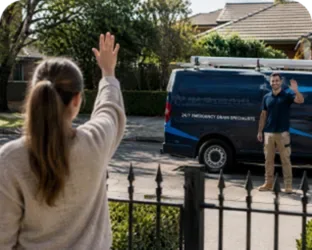
Found with equipment rather than by opening walls, starting with the two-minute test at your meter that tells you whether the water is leaving on your side at all.
Online Now!·--:--
Before anybody drives anywhere, there is a test worth two minutes of your time. Turn off every tap, the washing machine and the dishwasher, then watch the smallest dial on the water meter.
If it is perfectly still, nothing is escaping on your side and whatever you are worried about is something else. If it is creeping, water is leaving the system somewhere between the meter and your fixtures, and that whole length is the owner's responsibility rather than the authority's.
That distinction is worth knowing before you get a quote. The main and the meter belong to the water authority. Everything past the meter is yours, including the buried run across the front of the property that nobody thinks about until a bill arrives with an extra digit.
From there it is equipment rather than guesswork. Acoustic listening, pressure testing and thermal imaging narrow it to a point, and one opening gets made in the right place instead of three in hopeful ones.


Shut the supply off before you do anything else, then ring us. We will stay on the line while you find it.
Main and meter belong to the water authority. Everything past it belongs to you.
Which is why a leak on the buried run to the house is entirely on your bill.
The single most useful thing a householder can check, and it costs nothing.
Still dial means look elsewhere. Moving dial means water is leaving.
Water on an external run can disperse without ever showing at the top.
A bill that has climbed with no change in habits is frequently the only sign.
Not on the night you need it, in the dark, in the rain.
Most of what a burst costs happens between the failure and the tap being closed.
This ground has carried water infrastructure since the nineteenth century.
The asset enquiry is free and goes in before anybody breaks ground.
Fixed price agreed before anything starts. These are indicative 2026 ranges.
Water stopped and the situation stabilised, at any hour.
Acoustic, pressure and thermal, with nothing opened to find it.
Depending on the pipe, the material and how it has to be reached.
Fittings included, not just the labour.
Where it was, what failed, and what we did about it.

We ask what the dial does with everything off, because that one answer decides whether there is anything to look for.

Acoustic listening, pressure testing and thermal imaging until it is a point rather than an area.

One access point at the fault, rather than a run of hopeful ones along the way to it.

What failed, where it was and what it took, at the figure you agreed before we started.
Shut it off at the meter and ring. A licensed plumber can be moving toward you while you are still on the call.
Call 1300 381 569
What Queens Park locals ask us before booking a plumber.
Ask us yours
The meter answers it in two minutes. Turn every tap and appliance off, then watch the smallest dial. If it is still creeping, water is leaving somewhere on your side of the meter, and that side is the owner's responsibility. If it is completely still, the problem is somewhere else.
At the meter. The main and the meter itself are the water authority's. Everything from the meter into and around the property is yours, which is why a leak between the meter and the house is both invisible and entirely on your bill.
It is one of the most common calls we take. A leak on an external run can disperse underground for months without ever showing at the surface, and the bill is the only symptom you get.
Shut the water off at the meter before anything else, then ring. What a burst costs is almost entirely decided by how long the supply stayed on.
Acoustic listening, pressure testing and thermal imaging, chosen to suit what is leaking and where it runs. None of them involve opening a wall to have a look.
Then we locate it precisely first, and if reaching it means breaking ground, the free asset search goes in before anybody digs. On ground that has carried water infrastructure since the nineteenth century that is not a formality.
Locating a concealed leak is $250 to $600. A burst repair is $300 to $900. An emergency isolation and make-safe is $200 to $450, and the locate comes off the repair if you go ahead.
Tell us what the meter does with the taps closed and where anything is showing. Those two answers narrow it before anybody arrives.
Located with equipment, opened once, repaired at the figure agreed.
Online Now!·--:--